
Control-plane assembly
The real pole-control-plane runtime structure across bootstrap, API plugins, domain servers, caches, and storage.
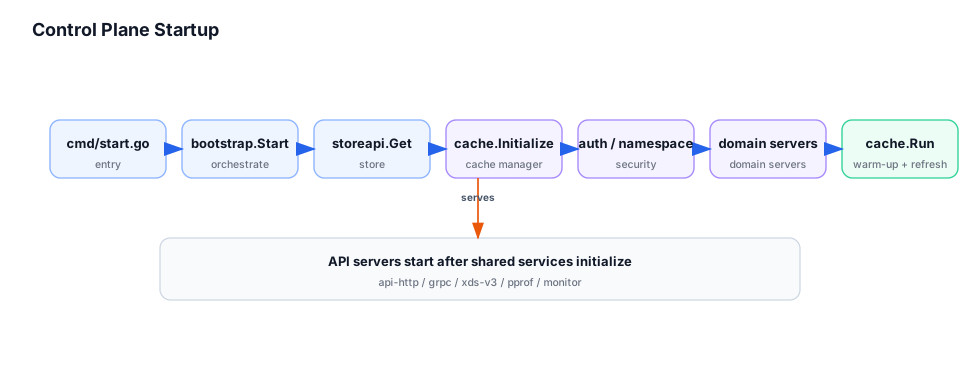
pole-control-plane is not a single HTTP CRUD service. Startup enters bootstrap.Start from cmd/start.go, then bootstrap/server.go assembles storage, cache, authorization, namespaces, discovery, governance, configuration, operations, and API servers in dependency order.
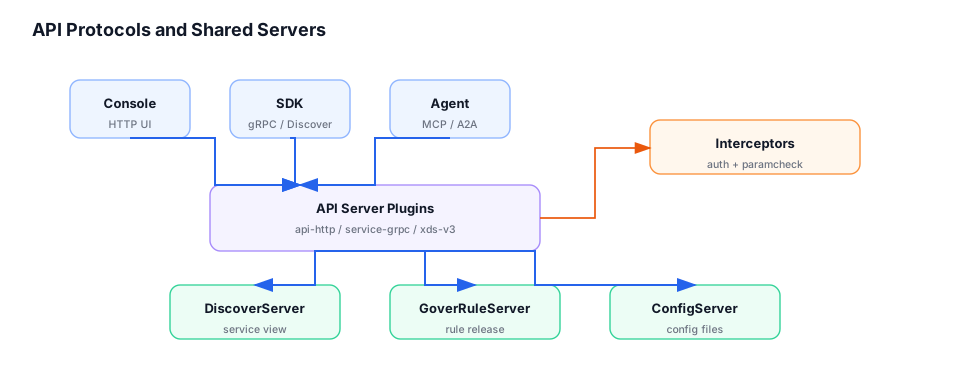
Protocol adapters can grow horizontally, but business capabilities reuse shared service.DiscoverServer, goverrule.GoverRuleServer, config.ConfigCenterServer, admin.AdminOperateServer, and cache.CacheManager.
Startup order
bootstrap.StartComponents matters:
- Obtain the store from
storeapi.GetStore(). cache.InitializecreatesCacheManagerand registers service, instance, governance, config, user, policy, MCP server, and A2A agent caches.auth.Initializeprepares user and strategy services required by auth interceptors.namespace.Initializebuilds the namespace service.StartDiscoverComponentsinitializes discovery, batch controllers, health checks, andservice.Initialize.StartGoverRuleComponentsinitializes governance servers.StartConfigCenterComponentsinitializes the configuration center.admin.Initializeassembles operations modules.cache.Runstarts warm-up and periodic refresh.
Business servers and cache objects are fully assembled before refresh loops start, so API servers serve already-initialized shared objects.
API servers are plugin slots
Slots under apis/apiserver register HTTP, discovery gRPC, xDS v3, Nacos, Apollo, and Eureka entry points. bootstrap.StartServers walks apiserver.Config, initializes each slot, and runs listeners in goroutines.
HTTP Run pulls already-initialized domain servers (admin, namespace, service, goverrule, auth, healthcheck). HTTP is transport and routing—not an independent business state owner.
Domain interceptors
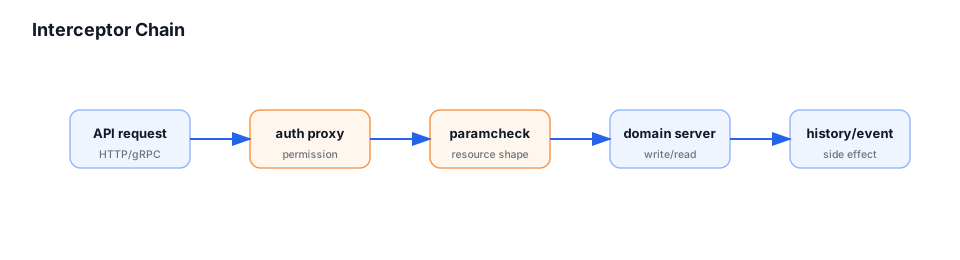
Discovery and governance share the same pattern:
RegisterServerProxyregisters proxy factories.GetChainOrder()returns["auth", "paramcheck"].InitServerwraps the concrete server in that order.
Authorization and parameter checks stay out of every protocol handler and remain consistent across HTTP, gRPC, and xDS.
Module boundaries
| Layer | Main entry | Responsibility |
|---|---|---|
| Bootstrap | bootstrap/server.go | Dependency-ordered assembly and lifecycle. |
| Protocols | plugin/apiserver/* | HTTP, gRPC, xDS, Nacos, Apollo, Eureka, MCP/A2A adapters. |
| Discovery | pkg/service | Services, instances, contracts, reporting, discovery responses. |
| Governance | pkg/goverrule | Nine governance families and releases. |
| Configuration | pkg/config | Groups, files, publishing, protocol adapters. |
| Authorization | apis/access_control/auth, plugin/access_control/auth | Users, policies, resource checks. |
| Cache | pkg/cache | Incremental views, active releases, AI registries. |
| Storage | plugin/store/mysql | CRUD, releases, incremental queries, transactions. |
Design implications
- Do not draw the control plane as “one HTTP API in front of a database”.
- API servers adapt protocols; domain servers own semantics; interceptors enforce cross-cutting rules; CacheManager serves low-latency reads; Store is the source of truth.
- AI Native registries join the same cache and HTTP assembly path—they are not a side UI.
See also deployment and ports and Control Plane.