
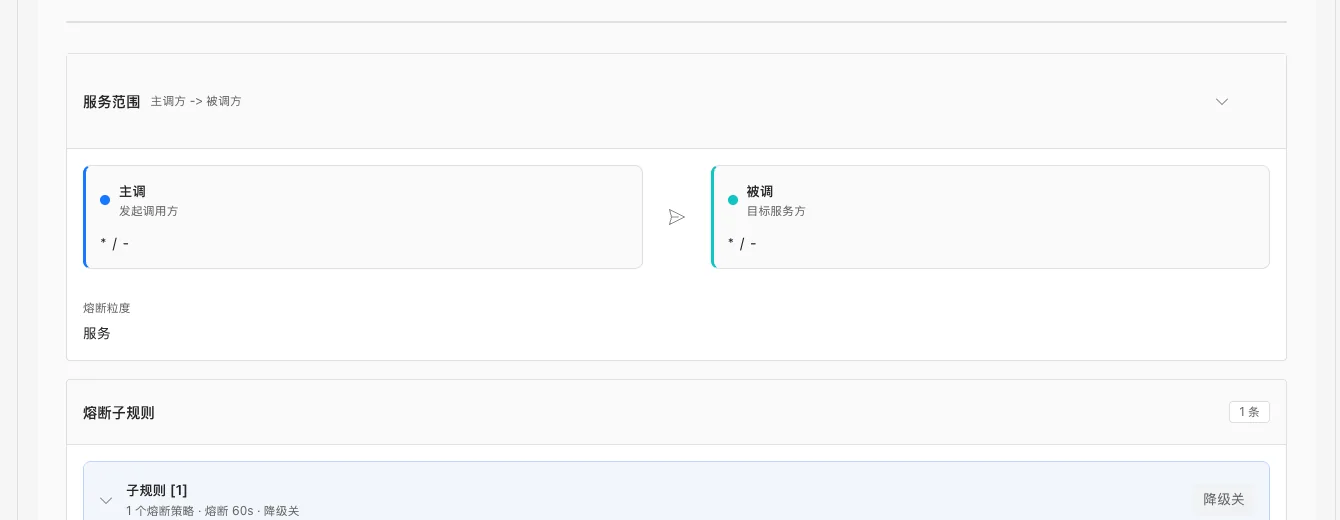
Service call scope
Define caller and callee first so rules stay tied to actual call paths.
SERVICE GOVERNANCE
Routing, lanes, rate limiting, circuit breaking, fault detection, lossless up/down, call authorization, traffic mirroring, and traffic Mock share one chain: rule → versioned release → active view.
01 / SCOPE BEFORE POLICY
Governance detail keeps service call scope, rule content, and history in one workspace—so policy review returns to a real call relationship instead of abstract parameter checks.
Define caller and callee first so rules stay tied to actual call paths.
View match conditions, actions, and governance parameters in one policy context.
Track how rules move from edit content to runtime versions, with recovery entry points.
02 / NINE DOMAINS
Nine rule types use consistent page language for scope, content, version, and release state. The three groups below are site information architecture—not extra storage tiers.
Select target versions by labels, weights, and request conditions.
Keep a set of related services closed on one environment identifier.
Copy requests to shadow services without changing the primary path result.
Constrain traffic entry by request dimensions and quotas.
Isolate unhealthy calls after anomaly thresholds trigger.
Identify unhealthy instances with active and passive signals.
Protect in-flight requests during instance lifecycle changes.
Enforce access policy by service identity and request conditions.
Return controlled responses by rule for integration and drills.
03 / TWO VIEWS
Revision marks content change in the management view; release version marks one deterministic runtime delivery. Both matter—they must not collapse into one “saved” state.
For create, modify, and review—shows current rule content, Revision, and pending release changes.
For runtime consumption—shows immutable versions in their corresponding release states.
04 / RELEASE LIFECYCLE
The release chain turns human judgment into deterministic runtime versions and keeps clear records for canary, full rollout, and recovery.
Adjust rule content and save edit state—this step does not change the runtime view.
Promote confirmed content to a release version with explicit canary or full scope.
Only release versions in active state enter the runtime consumption path.
Return to a known version through release history instead of reconstructing past rule state.
05 / RUNTIME LANDING
The control plane delivers deterministic governance views; each runtime consumes and enforces within its supported scope—we do not equate protocol compatibility with full capability parity.
Proxyless: consume supported governance views in-process against the control plane.
Multi-language contract cores (Go / Java / Python / Node.js / C++ / C#) that join the local Pole Sidecar via Sidecar Session.
Consume governance views within current component support, with extension points for more policies.
Consume published rules in mesh or gateway data planes.
Gain corresponding capability through compatible protocols without promising all nine rule types on every runtime.
MAKE RELEASE EXPLICIT