
Describe intent
The user explains in natural language which existing configuration to change and the desired outcome.
POLE AGENT / HUMAN-GATED CONTROL PLANE
Within signed-in user permissions, Pole Agent reads Namespaces, the MCP Registry, and existing configuration through Pole MCP. The LLM uses that context; internal proposal tooling and a confirmation kernel form update proposals. After human review and confirmation, it saves edit-state drafts only—release stays human-gated.
01 / REAL WORKBENCH
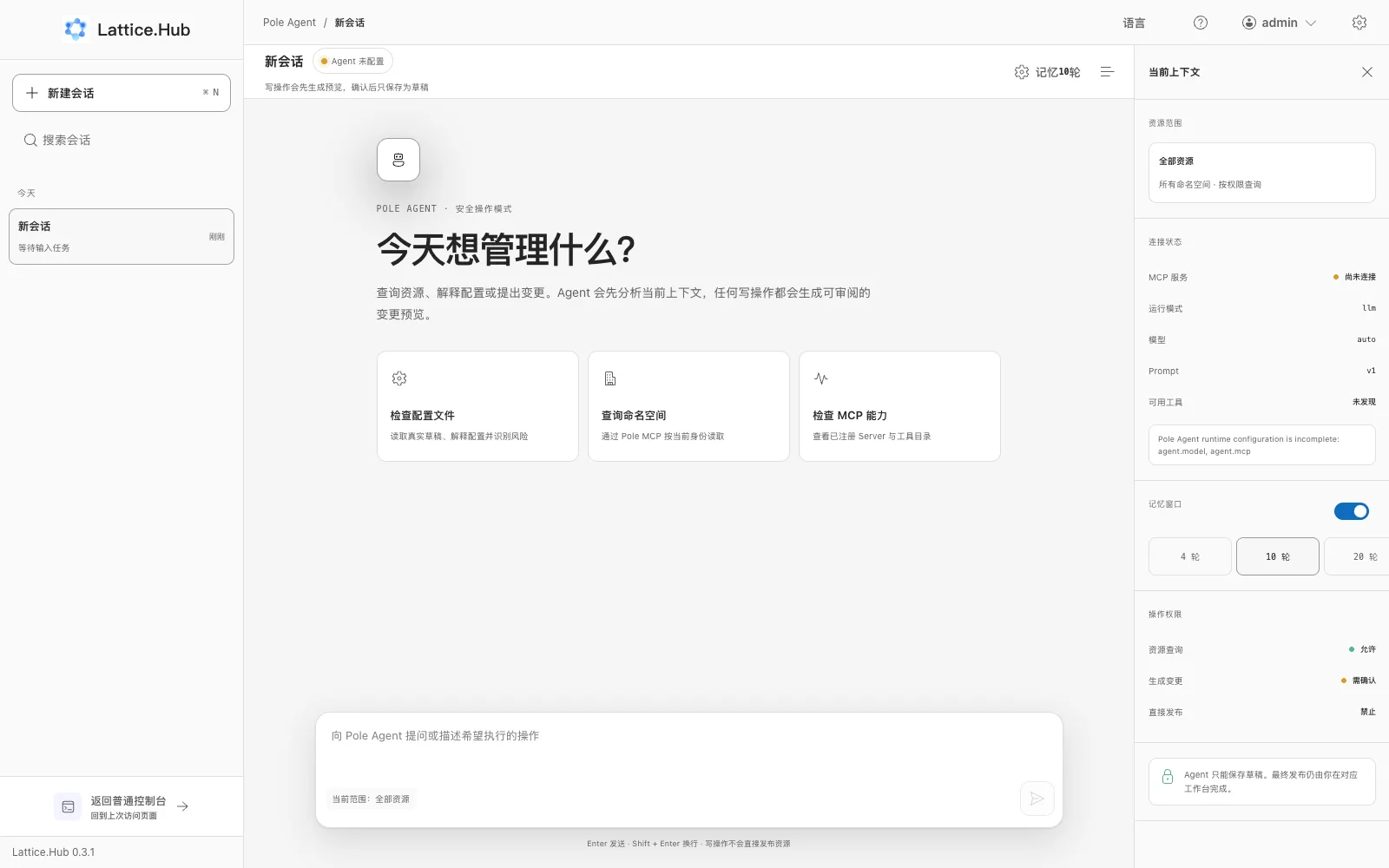
Pole Agent shows current resource scope, connection state, memory window, and operation permissions. When runtime configuration is incomplete, the workbench stays non-executable instead of letting the model proceed with unknown context.
02 / CONTROLLED CHANGE
Pole Agent’s value is not bypassing the control plane—it translates natural-language intent into inspectable diffs and returns explicit human confirmation to existing product flows.
The user explains in natural language which existing configuration to change and the desired outcome.
Read Namespace, MCP Registry, and configuration files within signed-in user permissions.
The LLM uses Pole MCP context; internal proposal tooling and the confirmation kernel produce an immutable proposal.
Original and proposed content appear side by side for human judgment.
After human confirmation, Agent writes content to edit-state draft only.
Subsequent release, rollback, and delete remain in deterministic product flows.
03 / SAFETY LAYERS
From tool allowlists to the confirmation kernel to an independent release chain, each layer narrows what Agent may do and preserves auditable product semantics.
Organizes conversation, context, and proposal preview so intent and diffs stay understandable.
Exposes allowlisted tools with explicit parameters—does not hand arbitrary internal capability to the model.
Validates signed-in identity, resource permissions, proposal content, and confirmation action—prompts are not the security boundary.
Activation, canary, rollback, and delete beyond drafts still enter deterministic human flows.
04 / THREE ROLES
Three concepts serve an AI-native control plane but do not replace one another. Separating roles prevents mistaking “discoverable” for “automatically executable.”
Understands control-plane context, prepares change, explains diffs—does not perform final release for the operator.
Registers discoverable MCP Servers, tools, and capability metadata—does not execute arbitrary tools.
Registers Agent Cards, skills, and capability metadata—does not run Agent tasks or host runtimes.
05 / CURRENT BOUNDARY
The site describes only the minimal closed loop that exists now. Boundaries will evolve with the product—we will not substitute roadmap for current fact.
06 / HUMAN RELEASE CHAIN
This is not weakening automation—it keeps AI in production control planes subject to permissions, versions, release, and rollback semantics.
HUMAN-GATED BY DESIGN